
ASTRO A20 X
ONE HEADSET,
EVERY CONSOLE
Logitech
PUX lead
LAUNCH: Oct 2025
TOOLS: Figma, After Effects, Adobe Suite, Google Suite
BUILT FOR THE MULTI-CONSOLE HOUSEHOLD
The A20 X is the console-first counterpart to the G522 LIGHTSPEED. Same industrial design, same audio architecture, same HMI standard — but designed around a different user. The G522 player has a PC. The A20 X player has a PS5 and an Xbox. Or a console and a Switch. Or all of the above.
A20 X was conceived alongside G522 as a concurrent industrial-design pair. They share most of the headset itself: 40mm PRO-G drivers, the same 48 kHz/24-bit DSP, the same broadcast-quality removable mic from the A50 X family, the same eight customizable LIGHTSYNC RGB zones (a first for the ASTRO Series). The differentiator is everything that happens between the headset and what the user is playing.
A Right Cup Built for Gaming
Where G522 keeps its left-cup HMI inherited from the standard — volume, mute, Bluetooth, power — A20 X adds a second cluster of controls on the right cup, and these are gaming-specific.
At the top, a quick-switch button toggles the headset between the two platforms connected to the PLAYSYNC base. Press once and the audio routes from one system to the other. The voice prompt confirms the new platform out loud, so the user always knows blindly which system they are on without breaking eye contact with the screen.
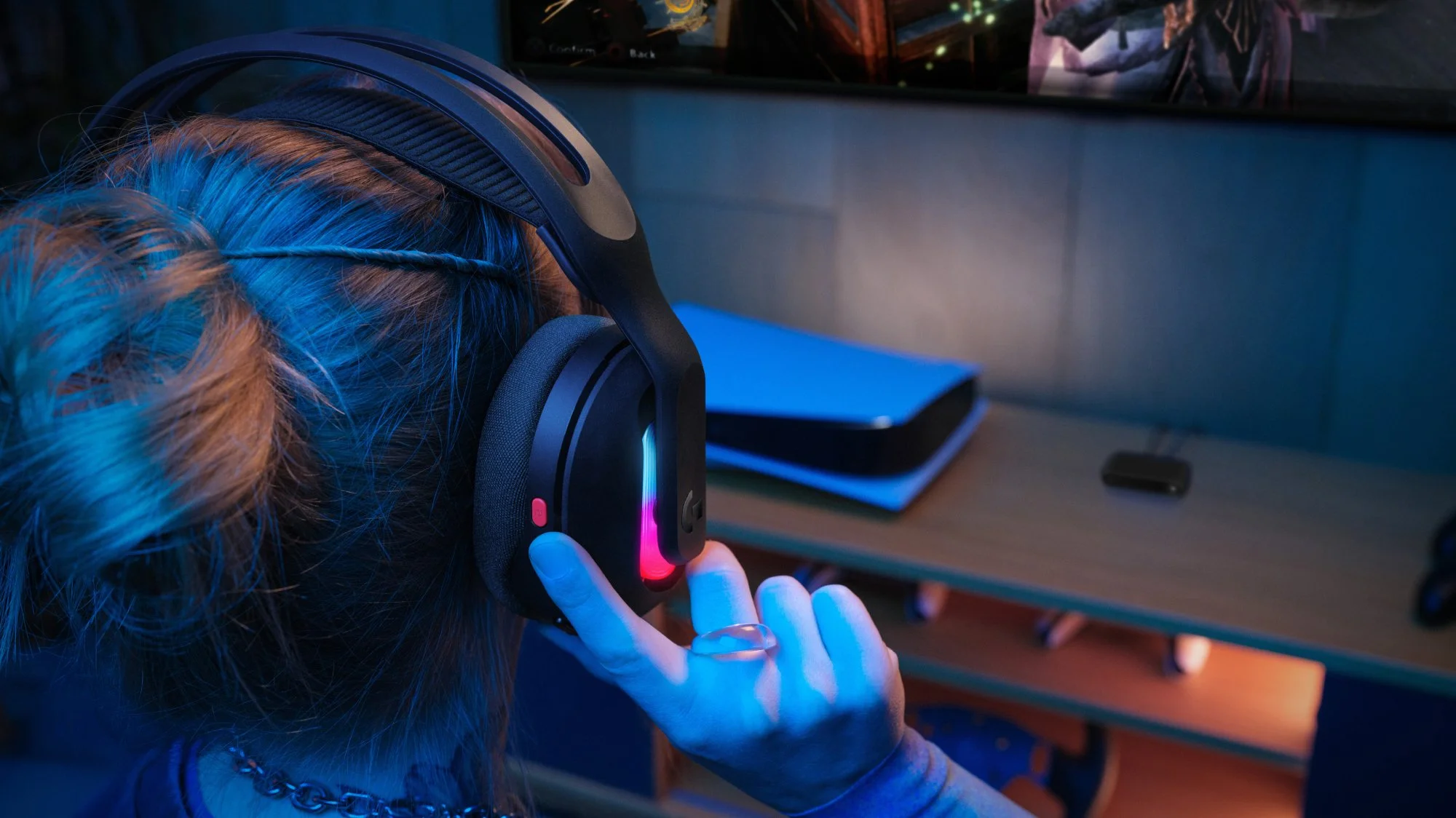
Right cup, top button: quick-switch between two connected platforms. The voice prompt confirms which system you are on.
Below the quick-switch sits a rocker — two interconnected push buttons, top for more game audio, bottom for more team chat. This is a strict gaming control. Game/Chat balance is a gameplay concept that does not exist outside competitive multiplayer; non-gamers do not have "team chat" as a separate audio stream to mix against the game soundtrack. A rocker is the right input here because the user is fluidly biasing their mix in the moment, mid-match — fingertip-driven, tactile, quick. Both controls live on the right cup because both belong to the platform-specific gaming context, sitting separately from the standard HMI elements on the left.
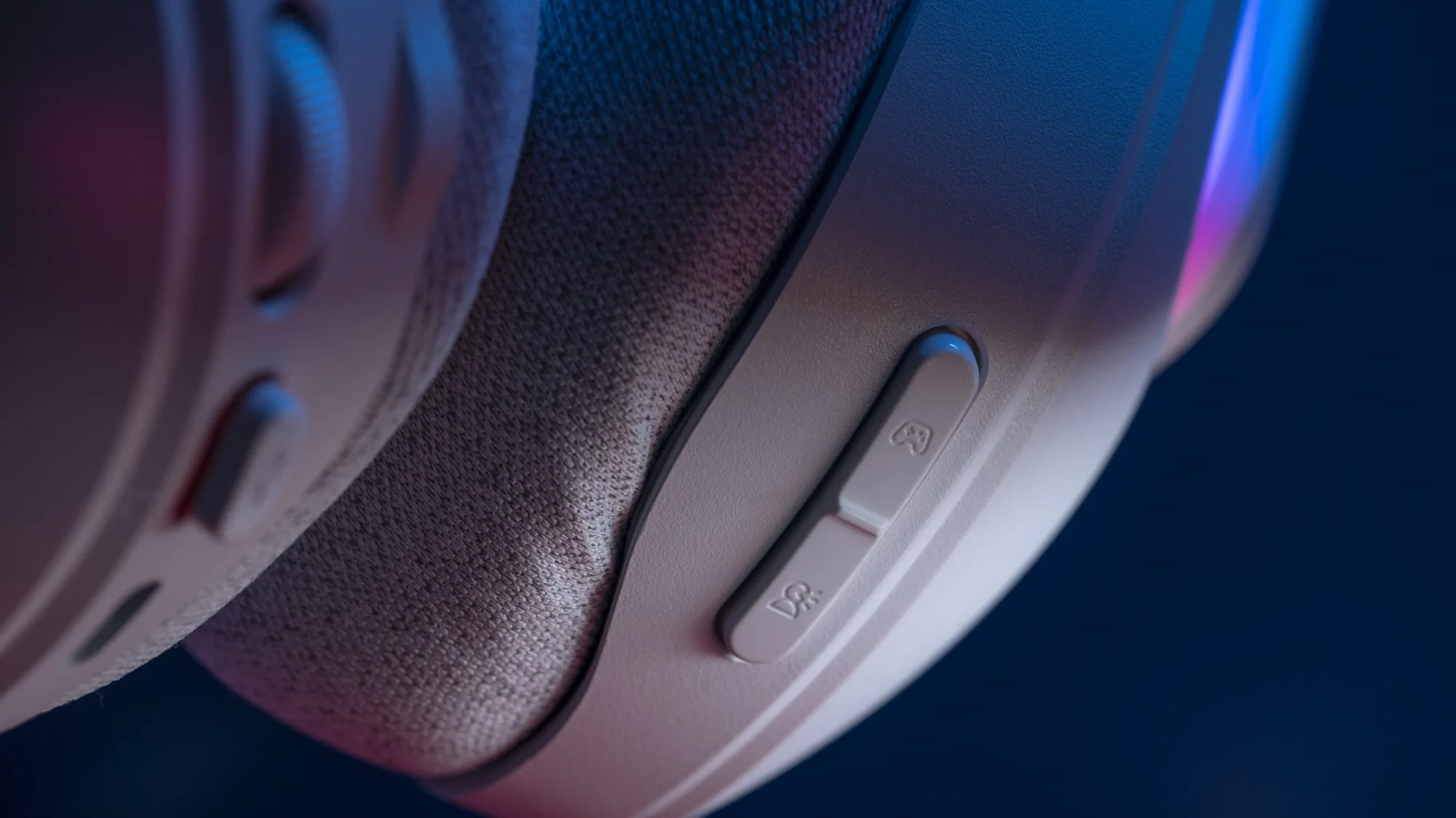
Right cup, lower rocker: top push for more game audio, bottom for team chat. Available on platforms that support dual-channel audio routing.
The PLAYSYNC Base
The other half of the system is PLAYSYNC AUDIO and the small base it ships in. Two USB-C ports on the back, each connected to a different platform. A switch behind each port for the user to indicate which device is plugged where.
What sounds simple in description was the deepest piece of the work. Different gaming platforms expose audio differently, and the puck's three switch positions on the back of the base — Xbox, PC, and USB — exist because Game/Chat dual-channel mixing is supported differently on each.
Xbox uses Microsoft's licensed audio protocol; the platform authenticates the headset and routes Game and Chat as separate channels natively. PC handles dual-channel through Windows' Default Device and Default Communication Device split, supported through standard USB Audio Class. The USB position is the fallback for everything else — Nintendo Switch, Steam Deck, and PlayStation, where Game/Chat separation is not exposed for third-party peripherals.
There is no single switching behavior that satisfies all platforms equally. I owned the matrix that mapped enumeration approaches against platform priorities, generated multiple switch-behavior options with pros and cons, and drove alignment with research on user priority across platforms, with program management on feasibility, and with product owners on the final call. The Game/Chat rocker only meaningfully works on platforms that support dual-channel audio routing — which is part of why the enumeration work mattered.

PLAYSYNC base: two USB-C ports, platform switches per port. The shipped behavior is the result of the enumeration matrix.
The Standard Carries Through
A20 X is the second headset to ship on the new global HMI standard, and the first in the ASTRO Series to use it. Most of the hardware UX inherits directly from the G522 — left-cup volume roller, mute toggle, flush Bluetooth button — adapted only where the multi-platform context required additional gaming-specific controls on the right. As with G522, I specified the companion experience across G HUB on Mac and PC and the Logitech G mobile app, including the mic settings, the EQ, and the customizable lighting.
For users who want one headset that handles every system in the house, the A20 X is the answer the standard made possible.
-
PLAYSYNC AUDIO: Two systems connected simultaneously, one button switches between them. Compatible with PC, PS5, PS5 Pro, Xbox Series X|S, and Nintendo Switch.
First ASTRO Series headset with RGB: Eight programmable LIGHTSYNC RGB zones, customizable through G HUB.
Built on the global HMI standard: Volume roller, toggle mute, flush Bluetooth button, plus a gaming-specific right-cup cluster — quick-switch and Game/Chat rocker — for platform-aware play.
Up to 90 hours of play, with strong customer reception: 40 hours with RGB on, 90 hours with RGB off. 20% reduced carbon impact versus the prior generation. 4.6 out of 5 stars across hundreds of customer reviews on Best Buy and Logitech's site.